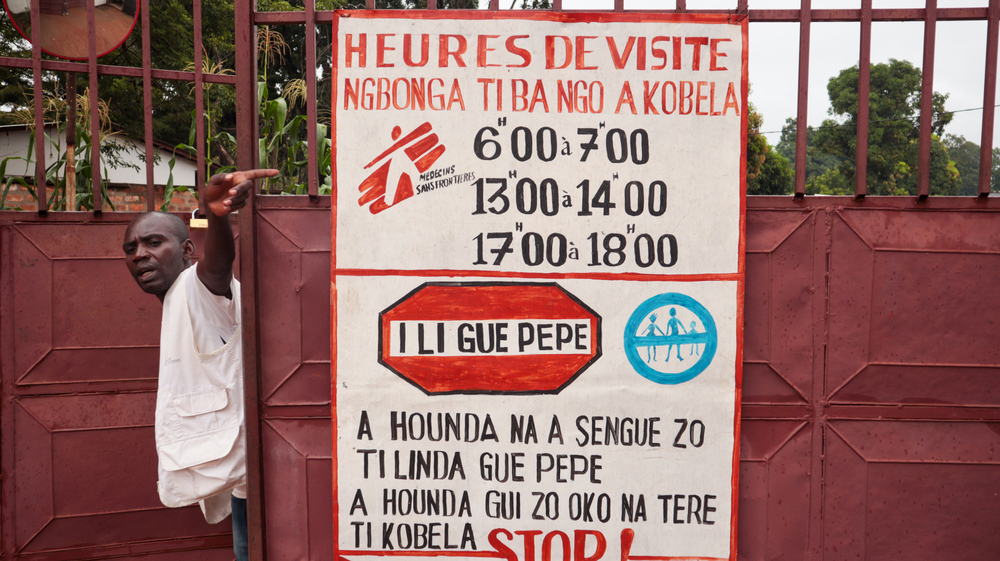
A view of the entrance of the Bossangoa Regional University Hospital, supported by MSF since 2013, in collaboration with the Ministry of Health. MSF supports the hospital’s emergency room, intensive care unit, paediatrics department, inpatient therapeutic feeding centre, pharmacy, and laboratory. © Evy Biramocko/MSF

MSF CAR: Malaria and malnutrition: a double threat for children in the Central African Republic ​

23 November - Every year in Bossangoa, northern Central African Republic, the rainy season brings a surge in malaria-carrying mosquitoes, just as families’ food reserves run out. The result is a peak in malaria and malnutrition among children, putting pediatric services under intense pressure: In July 2026 alone, Doctors Without Borders/Médecins Sans Frontières (MSF) medical teams recorded 5,162 confirmed malaria cases in the area. In collaboration with the Central African Ministry of Health and Population, MSF built a 52-bed pediatric ward at Bossangoa Regional University Hospital.

Ornella sits next to her child suffering from malnutrition, at Bossangoa Regional University Hospital. Her child has just been weighed to assess how his condition is progressing. She says she received advice from the medical team on food and personal hygiene to prevent illness. © Claire Morand/MSF

Ornella’s young son is being treated in the ward. Like many admitted during the rainy season, he is malnourished and showing signs of malaria. "At first, my child had diarrhea, then he started vomiting and became generally weak," says Ornella, who sells vegetables at the market. "[When we arrived at the hospital], they gave us tablets, injectable medicines, and also milk and Plumpy’Nut [a peanut-based paste used to treat malnutrition]."

In July and August, farming families in and around Bossangoa endure the lean season. Their food stocks, especially cassava and groundnuts, run out. After the planting period, some families struggle to feed themselves. This resulting peak in malnutrition often overlaps with the malaria peak. Between January and September 2026, medical teams treated 36,019 people with malaria in the region, mostly children.

Morgan is carrying one of his five children, who is suffering from malnutrition and malaria, at the Bossangoa Regional University Hospital, supported by MSF. “My child started by vomiting and then had constant diarrhoea. We took him to a village health centre, but the treatment didn’t work, so we were advised to come straight to the hospital" says Morgan. © Claire Morand/MSF
Priscile, 35, sits with her two children who are receiving treatment for malnutrition and tuberculosis, at the Bossangoa Regional University Hospital, supported by MSF. ​ The young woman has been referred from her village health centre to the hospital and travelled there by motorcycle taxi, supported by MSF. ​ “The youngest has received two units of blood and is eating with a healthy appetite again, whilst the eldest is still receiving treatment for tuberculosis and continues to suffer from skin rashes” she says. © Claire Morand/MSF

A vicious cycle ​

When a child is acutely malnourished, their immune system becomes weakened, making it harder to fight infections such as malaria. In turn, malaria can further worsen a child’s nutritional status through inflammation, loss of appetite, anemia, and impaired growth. "Eighty percent of patients with malnutrition also have malaria," says MSF nursing care manager Jean-Paul Kikwayabo at Bossangoa hospital.

Together, the two diseases have serious consequences, and children often reach care late: health facilities are far away, families lack the money for transport or treatment, and many first turn to traditional remedies. "Some patients arrive in a relatively stable condition, while others arrive in a coma; they can remain in a coma for two to three days," says Kikwayabo.

Jean-Paul Kikwayabo (on the left), MSF senior nurse, surrounded by nurses of the minister of health, at Bossangoa Regional University Hospital. He supervises the team of nurses who care for stabilising ​ the young patients suffering from malnutrition and often another condition, such as malaria or tuberculosis. “The recent extension of the pediatrics building improves the quality of care, as there will be more space between the beds and greater comfort; even the nurses feel so much more at ease whilst they’re working, and that motivates everyone” he says. © Claire Morand/MSF

Relieving pressure on pediatric services and improving quality of care

In response, MSF invested in strengthening capacity and quality of care at Bossangoa Hospital, where it has worked closely with the Ministry of Health and Population since 2013. This includes building a new facility dedicated to treating malaria, rehabilitating the Inpatient Therapeutic Feeding Centre (ITFC), and installing solar panels to provide a continuous, sustainable electricity supply. ​

During previous peak periods, overcrowding in the pediatric and intensive care wards sometimes forced two patients to share a bed, which increased the risk of cross-infection, making recovery harder. “First, it helped relieve congestion at the hospital. The second benefit is that it improves the quality of care,” Kikwayabo explains. ​

A view of the newly constructed 52-bed pediatric extension at the Bossangoa hospital, opened in early August 2026 for children under 15 suffering from malnutrition and malaria. Built by MSF alongside the Central African Ministry of Health, it helps ease overcrowding at Bossangoa Regional University Hospital during the seasonal double peak of malnutrition and malaria. © Evy Biramocko/MSF
A view of the extension of the pediatric ward at the Bossangoa Regional University Hospital. Young patients suffering from malnutrition, often in conjunction with other conditions such as malaria and tuberculosis, are being treated in this new building, which was opened by MSF in August 2026, in collaboration with the ministry of health. This new 52-bed facility is designed to cope with the influx of patients, to stabilize them and ensure close supervision till full recovery. © Claire Morand/MSF

Bringing care closer to home

Outside the town, access to healthcare remains a major challenge. In the surrounding areas, reliance on traditional medicine, distance, and cost continue to delay treatment for rural communities. To reach patients more effectively, MSF is strengthening its presence along the outlying roads. Four days a week, a medical team travels from Bossangoa to around a dozen surrounding villages to support the Minister of Health teams in the health facilities of the outskirts with the treatment of patients whose condition does not require hospitalization. This brings care closer to home and helps ease the pressure on Bossangoa hospital.

Parents, whom children are suffering from malnutrition, are participating in a cookery discussion at the Bossangoa Regional University Hospital. ​ “We explain to the carers how to prepare cassava leaves with okra and meat. So, to prepare it properly, you mix it with shea oil, peanut paste, onion, and spices. It is the spices that ensure there are vitamins in the food,” says Villebranche Denduba, a nutrition assistant. © Evy Biramocko/MSF

Photos (High Quality versions available)

Malaria and malnutrition combined a double burden for children in the Central African Republic_2026Nov23_1648.pdf

PDF 1.4 MB


Share

Get updates in your mailbox

By clicking "Subscribe" I confirm I have read and agree to the Privacy Policy.

About MSF UK

This is the media office for the UK office of Médecins Sans Frontières/Doctors Without Borders (MSF), an international, independent, medical humanitarian organisation that delivers emergency aid to people affected by armed conflict, epidemics, natural disasters and exclusion from healthcare. MSF offers assistance to people based on need, irrespective of race, religion, gender or political affiliation.

MSF UK's privacy notice is available here.

Address: Level 5, Artesian, 9 Prescot Street, London E1 8AZ

Contact

www.msf.org.uk